

Maya's Story
The Section 8 Negotiation Everyone Said Was Impossible


Last Tuesday, Maya stared at an email on her phone for the third time that day. The subject line: “Lease Renewal Notice.” The message was polite. Professional. And it was going to cost her $3,600 a year she didn’t have.
In Philadelphia, we negotiate everything. We negotiate taxi fares, bar tabs, parking spots. But when it comes to housing—especially affordable housing—we’re told negotiation is off the table. “That’s just what it costs.” “Take it or leave it.” “Section 8 landlords don’t negotiate.”
I couldn’t help but wonder: When did accepting the first offer become the only option? And what would happen if we stopped accepting what we’re told and started asking for what we need?
Maya didn’t just wonder. She negotiated.
Last week, I introduced you to five women who learned that everything’s negotiable™ in real estate.
Today, I’m telling you Maya’s complete story.
Maya, 32. Single mother of two. Philadelphia. Section 8 voucher holder.
This is the negotiation everyone told her was impossible.
“Section 8 landlords don’t negotiate.”
“You should be grateful to have housing at all.”
“If you push back, you’ll lose your apartment.”
She negotiated anyway. And saved $2,700 per year.
Here’s exactly how she did it.
The Problem
Maya has been renting a 2-bedroom apartment in Philadelphia for three years.
Her Situation:
Income: $38,000/year (administrative assistant)
Rent: $1,200/month, within the limits of her Section 8 voucher
Two children: ages 8 and 5
Never late on rent. Zero complaints. Model tenant.
Then she received this email:
“Dear Maya, Your lease renewal is coming up. Due to increased property costs, your new rent will be $1,500/month beginning March 1. Please sign the attached renewal by February 15. Thank you.”
The Math:
New rent: $1,500/month
Her voucher maximum: $1,200/month
Additional out-of-pocket: $300/month = $3,600/year
On a $38,000 salary, $3,600 is nearly 10% of her gross income. After taxes, it’s closer to 13%.
She couldn’t afford it.
What Everyone Told Her
Her caseworker: “That’s the market. Section 8 landlords know they can charge more because demand is so high. You’ll probably need to find a new place.”
Her friend: “Girl, don’t make waves. You have housing. That’s more than a lot of people with vouchers can say.”
Her mother: “Maybe you can pick up a second job? I can watch the kids some evenings.”
Online forums: “Section 8 landlords don’t negotiate. They know you have limited options.”
Everyone had the same message: Accept it or move.
What Maya Did Instead
Maya found this newsletter three weeks before her lease renewal deadline.
She read about The PREP Framework™.
She decided to try it. Because what did she have to lose?
Here’s exactly what she did, step by step.
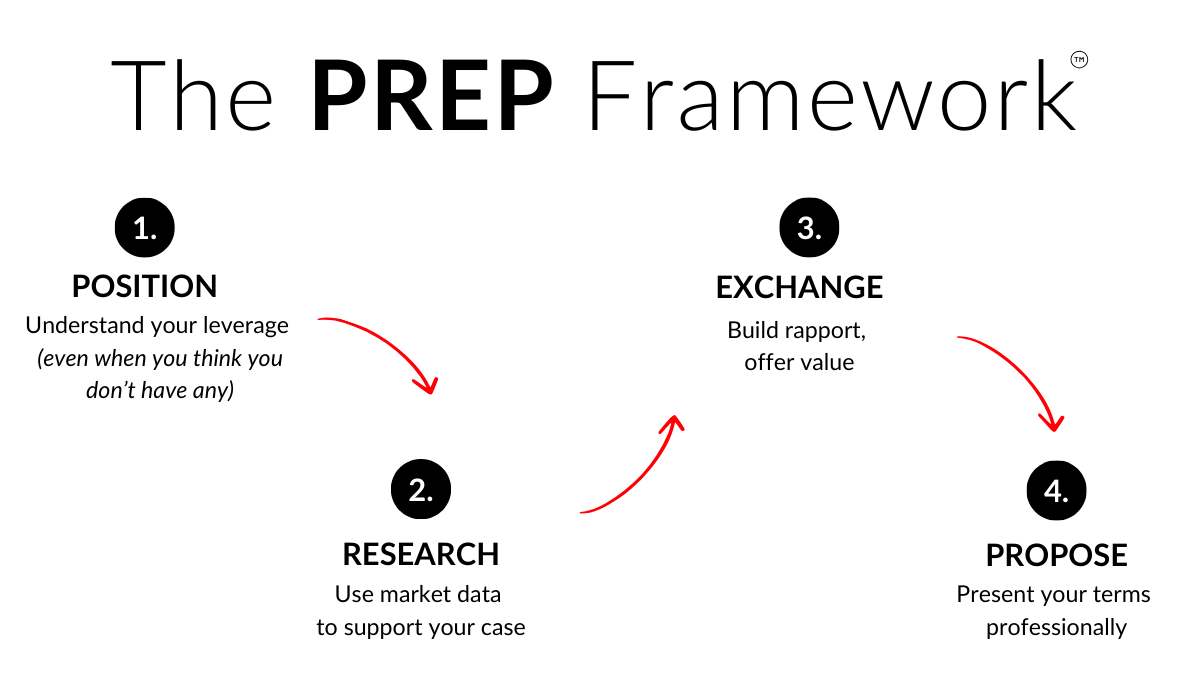
Step 1: POSITION - She Assessed Her Leverage
Maya sat down and honestly evaluated: “Do I have ANY leverage here?”
Most people would say no. She’s a Section 8 tenant. The landlord has all the power, right?
Wrong.
Here’s what Maya wrote down:
My Value to the Landlord:
I’ve never been late on rent in 3 years (guaranteed payment every month)
I’ve never called for maintenance (I fix small things myself)
My kids are well-behaved (no complaints from neighbors)
I keep the apartment clean (minimal turnover work when I leave)
Section 8 pays on time, every time (no chasing tenants for money)
Landlord’s Costs if I Leave:
Lost rent during vacancy (1-2 months = $1,200-2,400)
Turnover cleaning and minor repairs ($500-1,000)
Finding new Section 8 tenant (time + hassle)
Risk of bad tenant (could cost thousands in damages)
Inspection delays if new tenant needs voucher approval
Maya’s realization: “If I move out, it costs him at least $2,000. That’s almost as much as he’s asking me to pay extra over the year.”
Translation: She had more leverage than she thought.
Step 2: RESEARCH - She Gathered Data
Maya spent 2 hours researching. Here’s what she found:
Fair Market Rent (FMR) in Philadelphia:
HUD’s published FMR for 2-bedroom: $1,285/month
Her landlord was asking: $1,500/month (17% above FMR)
Her current rent: $1,200/month (7% below FMR)
Comparable Apartments:
She searched Zillow for 2BR apartments in her neighborhood
Found 5 comparable units: $1,250-1,400/month
Average: $1,325/month
His ask of $1,500 was above market
Section 8 Rules:
Learned that Section 8 rent increases must be “reasonable”
HUD defines reasonable as “in line with market”
Landlord can request increase, but Housing Authority must approve
HA reviews comparable rents when approving
Her caseworker’s leverage:
Called her caseworker (different person than who told her to just accept it)
Asked: “Can the Housing Authority mediate if a landlord asks above-market rent?”
Answer: “Yes. We can request market comparables and negotiate.”
Maya’s realization: “He’s asking 17% above what HUD says is fair market rent. The Housing Authority won’t approve this without justification.”
Step 3: EXCHANGE - She Had a Strategic Conversation
Maya didn’t fire off an angry email saying “NO.”
She called her landlord. Here’s what she said:
MAYA: “Hi Mr. Johnson, thank you for the renewal notice. I’ve been really happy here, and I’d like to stay. I wanted to talk about the rent increase before responding. Do you have a few minutes?”
LANDLORD: “Sure, Maya. I know it’s a big increase, but costs have gone up a lot.”
MAYA: “I understand that. Can you help me understand what’s driving the 25% increase? I want to make sure I’m seeing the full picture.”
LANDLORD: “Well, property taxes went up. Insurance went up. Everything costs more now.”
MAYA: “That makes sense. Can I share what I’ve found in my research? I want to work something out that’s fair for both of us.”
LANDLORD: “...Okay.”
MAYA: “I pulled HUD’s Fair Market Rent for our area. For a 2-bedroom, they list $1,285 as the market rate. I also looked at 5 comparable apartments in the neighborhood. They’re renting for $1,250 to $1,400, with an average around $1,325.
Your proposed $1,500 is about $200 above what seems to be market rate. Since my voucher maxes out at $1,200, I’d be paying $300 out of pocket—which is actually above what market-rate tenants are paying without vouchers.
I also know that if I need to move, the Housing Authority will look at comparables when approving rent for my new place. They’re likely to approve something in the $1,250-1,350 range—not $1,500.”
LANDLORD: “Hmm. I didn’t realize the market was that.”
MAYA: “I’ve been a good tenant for three years. I’d really like to stay if we can make the numbers work.”
Then she stopped talking. She let him process.
Step 4: PROPOSE - She Offered Solutions
After a pause, her landlord said: “So what are you thinking?”
Maya proposed three options:
OPTION 1:
“I renew for 2 years at $1,275/month—which is still a 6% increase from my current $1,200, but it’s within the HUD market rate. You get rent stability and don’t have turnover costs. And my voucher covers the full amount.”
OPTION 2:
“I renew for 1 year at $1,300/month. I pay $100 out of pocket, but we revisit next year based on what actual market rents are then.”
OPTION 3:
“You keep the rent at $1,200 for one more year, and I help you find another good Section 8 tenant when I eventually do move. I have connections through my caseworker and know several families looking.”
Then she added:
“All three options save you the $2,000-3,000 in turnover costs, keep a reliable tenant, and maintain guaranteed payment. And they’re all at or below actual market rates for the neighborhood.”
She stopped talking again.
What Happened Next
Her landlord said: “Let me think about it and get back to you.”
Two days later, he called:
“I’ll do Option 1. $1,275 for two years. That’s actually better for me than dealing with turnover every year anyway.”
Maya saved $225/month.
Over two years: $5,400 total savings.
But more importantly: She kept her housing. Her kids didn’t have to change schools. She proved that Section 8 tenants CAN negotiate.
What This Means for You
Maybe you’re not a Section 8 tenant. But Maya’s framework applies to ANY rent negotiation.
Here’s what she did that you can copy:
She didn’t accept the narrative that she had no power (Position)
She did 2 hours of research on market rents (Research)
She approached the conversation collaboratively, not defensively (Exchange)
She offered options, not ultimatums (Propose)
The specific tactics:
✅ She quantified the landlord’s turnover costs (showed him what losing her would actually cost)
✅ She used HUD data and market comps (data, not emotion)
✅ She gave him three choices (all favorable to her, all acceptable to him)
✅ She framed herself as a solution, not a problem (reliable tenant vs. turnover risk)
✅ She stayed silent after proposing (let him make the decision)
The Lessons
1. “Section 8 landlords don’t negotiate” is a myth
They do. When you understand their economics and present data, they negotiate.
2. Leverage isn’t about who makes more money
Maya had leverage because leaving cost him money. That’s leverage.
3. Research changes everything
Without the HUD data and market comps, Maya had an emotional argument. With data, she had a business case.
4. Options are more powerful than demands
“Give me $1,200 or I’m leaving” = confrontational
“Here are three options that work for both of us” = collaborative
5. Two hours of research saved $5,400
That’s $2,700 per hour—and negotiation skills she’ll use for life.
Maya Today
Maya is still in her apartment. Her rent is $1,275—well within her voucher.
But more than that: She’s saving money for the first time in years.
The $225/month she’s NOT paying to her landlord goes into a savings account.
She’s learning about first-time homebuyer programs. Down payment assistance. How to qualify for a mortgage.
In 3-4 years, Maya will use Sarah’s strategies (next week’s story) to buy her own home.
Because once you learn that everything’s negotiable™, you stop accepting “that’s just how it works.”
Get Maya’s Toolkit FREE—Code Expires Friday

Use code MAYA2026 at checkout for 100% off The Rent Negotiation Toolkit – for Market-rate and Section 8 Voucher renters
Expires: Friday, January 31, 2026 at 11:59 PM EST
After that, the toolkit is $27. Don’t miss out.
What’s Coming
Sarah’s Story
How a 28-year-old marketing coordinator with $15,000 saved bought her first home AND won a bidding war.
Sarah lost her first offer—bid $400,000 and still lost to a lower cash offer. Three weeks later, she won her second bidding war at $398,000 by competing on terms instead of price.
Her story is about what happens when you stop trying to outbid everyone and start understanding what sellers actually want.
Negotiating rent soon? Reply with your situation—I might feature it (anonymously) in a future newsletter.
Know a Section 8 voucher holder? Forward this email. Maya’s story could save them thousands.
Your Action Step This Week
If you’re negotiating rent right now:
Look up HUD’s Fair Market Rent for your area (Google: “HUD FMR [your city]”)
Pull 5 comparable apartments on Zillow (similar size, neighborhood)
Calculate your landlord’s turnover cost (typically $2,000-5,000)
Write down your value as a tenant (payment history, maintenance, etc.)
This prep work takes 2 hours. It could save you thousands.
Current Market Context
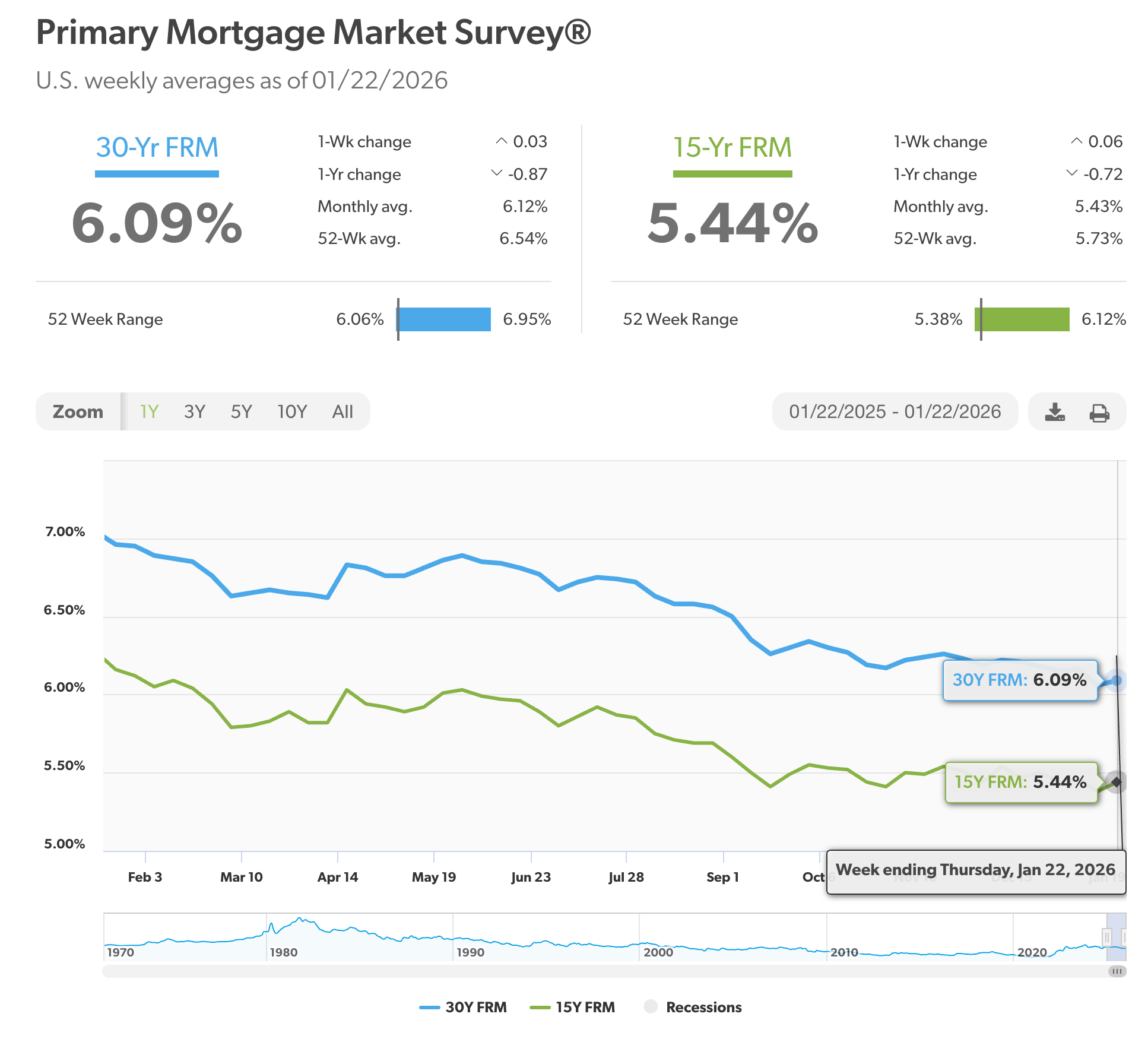
Source: Freddie Mac 01/22/2026
Here’s what you need to know about the market right now:
Mortgage Rates
30-Year Fixed: 6.09% ↑
15-Year Fixed: 5.44% ↑
What Happened Last Week:
Rates ticked up slightly (3 basis points on 30-year, 6 basis points on 15-year) after five consecutive weeks of declines but remain at their lowest levels in three years as economic data continues to show resilience.
Market Impact:
Despite the small uptick, rates are still nearly a full percentage point lower than this time last year (6.96% vs 6.09%). With the economy improving and affordability significantly better than 2025, Freddie Mac reports more homebuyers are entering the market. Economists expect rates to stabilize in the low-6% range through February.
Action Items:
Buyers: Now is an excellent time to act—rates are at 3-year lows and more inventory is hitting the market as spring approaches. Get multiple quotes from lenders; rate shopping can save you thousands over the life of your loan.
Refinancing: If you bought in late 2023-2024 when rates were 7%+, you could now save $100-200/month by refinancing. Worth running the numbers with 2-3 lenders.
Investors: Lower rates + improved affordability = less buyer competition but better cash flow potential. Properties that sat last year are moving now—don’t sleep on this window.I want to introduce you to five women.

Launching Soon - The Offer: Everything’s Negotiable™
Click for early access - you’ll be first to know when we launch, plus early bird pricing and exclusive bonuses.

Eve Moss
Founder, Women + Real Estate™
womenplusrealestate.com
Subscribe below to get regular newsletters in your inbox.
Which woman’s story resonates with you most? Reply and tell me.
Your answer helps me understand what matters most to you—and shapes the content you see here.
Thank you for being here. Everything’s negotiable.
About the Women + Real Estate™ Opportunity Fund - 10% of all product sales fund scholarships and micro-grants for women in housing transitions. When you purchase any product, you’re helping another woman negotiate from strength.
Disclaimer: The stories shared in this newsletter are based on real negotiation scenarios but are presented as composite characters with changed names and details to protect privacy. Content is for educational purposes only and does not constitute legal, financial, or professional advice. Real estate laws and regulations vary by location. Consult qualified professionals before making real estate decisions. Section 8 policies, commission structures, and contract terms differ by jurisdiction. What worked in these examples may not apply in your situation. Past results do not guarantee future outcomes.
Legal Notice: The PREP Framework™ and Everything’s Negotiable™ are trademarks of Chavah Media Ltd. | Women + Real Estate. All rights reserved.
© 2026 Chavah Media Ltd. | Women + Real Estate™ . All rights reserved.
rent prices are just going through the roof!